Welcome. This short guide lays out clear steps for beginners in Singapore who want trustworthy information before they invest. It frames safety as repeatable habits, not a one-time fix.
Understand first that cryptocurrency is not insured like bank deposits. You can lose funds if an exchange fails or an account is stolen, and recovery is often impossible. Prevention matters far more than fixing problems later.
What follows is a glance at the full journey: choosing a reputable exchange, creating an account, funding with fiat, placing trades, and moving long-term holdings into a wallet you control. Expect practical, Singapore-focused notes on licensing and common local options.
This article will help you avoid common mistakes: weak passwords, SMS 2FA, leaving coins on exchanges, phishing, and wrong-address transfers. Use the steps here to match actions with your risk tolerance and investment decisions.
Key Takeaways
- Crypto lacks FDIC-style protection; prevention is essential.
- Start with research, secure setup, and a storage plan.
- Move long-term holdings to wallets you control.
- Avoid weak passwords and SMS-based two-factor methods.
- Follow Singapore-specific guidance on regulated providers.
Crypto Safety Basics for First-Time Buyers in Singapore
Cryptocurrency acts like transferable value, yet it is not legal tender from any central bank. You can send value to someone else, and it can function like money in daily use. But MAS does not issue or guarantee these tokens, so normal bank protections do not apply.
Decentralization means fewer middlemen. That gives users direct control but also fewer protections when problems happen. If an exchange or service fails, there is no automatic safety net like the SDIC that covers some bank deposits in Singapore.
No deposit insurance translates into real outcomes: insolvent platforms or drained accounts may leave your crypto assets unrecoverable. Unlike a bank account insured up to S$100,000 for eligible deposits, most cryptocurrency balances have no similar guarantee.
Blockchain transactions are final. Sending to the wrong address or approving a malicious request is often irreversible. Security.org and other sources note that recovery is usually impossible once funds leave your control.
- Common loss scenarios: phishing approvals, SIM swap takeovers, malware, and address hijacks.
- Practical focus: secure account logins, careful custody of private keys, and double-check transfers every time.
For clear next steps and easy transfers, see an internal guide on easy transactions. Keep process over prediction: protect access, not just predict volatility.
Know the Rules Before You Buy: Singapore Regulations, Licenses, and Red Flags
Before signing up, know which licences a provider holds and what that means for your money. In Singapore, licensed Digital Payment Token (DPT) services cover activities like buying and selling tokens, custody, and transfers. Licensing reduces certain risks by requiring local compliance and clearer consumer protections.
Spotting regulation signals
Check an operator’s licence status, corporate entity details, and published fee pages. A valid listing with the regulator and clear local contact info are practical trust signals.
Red-flag checklist
- Unlicensed operators or vague legal names
- Guaranteed returns or high-pressure sales tactics
- Unclear custody terms or outsourced wallets
- Support that only uses WhatsApp or Telegram
Examples and ATM note
Popular licensed pathways include brokerage-style apps and established exchanges such as Crypto.com and Coinhako; Gemini has in-principal approvals. Bitcoin ATMs were banned in 2022, so use licensed platforms for fiat on-ramps and trading.
Before you sign up — asked questions
Expect ID checks, proof of address, and basic risk disclosures when creating an account. Save screenshots of licence pages, fees, and terms as proof of your research.
How to Buy Crypto Safely by Choosing a Reputable Cryptocurrency Exchange
Pick an exchange that shows clear, public security practices and transparent incident history. A solid cryptocurrency exchange will explain custody, cold storage ratios, audits, and past responses to hacks.

Security signals to prioritise
Look for a high cold storage allocation (some report ~95% offline), independent attestations or penetration tests, active bug bounties, and strong 2FA options.
Reimbursement policies and limits
Read reimbursement terms carefully. Platform-level breaches may be covered, but losses from phishing, SIM swaps, or leaked credentials usually are not.
Comparing exchange types
Centralised exchanges are beginner-friendly and liquid. Integrated brokers offer stocks plus crypto in one app. P2P gives flexibility but raises scam risk for less experienced traders.
| Type | Best fit | Key security point |
|---|---|---|
| Centralised exchange | Active traders | Liquidity, custody controls, audit transparency |
| Integrated broker | Users with multi-asset needs | Account protections, single-sign integration |
| P2P | Experienced users | Escrow use, identity checks, higher scam surface |
Shortlist for Singapore users
Commonly researched platforms include Coinhako, Crypto.com, Kraken, Coinbase, and Gemini (licence status varies). Broker-style apps such as moomoo and POEMS may also list tokens.
Fit guidance: traders who need advanced orders should prioritise liquidity and fees. Long-term holders should value withdrawal reliability and custody controls. Test any platform with a small deposit and a withdrawal trial before adding meaningful funds.
For more background on exchange security indicators, see exchange security guidance.
Set Up Your Exchange Account the Secure Way
Start account setup with a clear checklist so your access stays under your control. A few careful steps at signup cut risk and shape future security choices.
Identity verification as a legitimacy signal
Identity verification is required by most licensed providers in Singapore. It shows the platform follows local rules and helps prevent impersonation during support cases.
Complete KYC through official forms only. Do not send photos or documents over chat apps that are not part of the exchange’s verified portal.
Password hygiene and password manager use
Use a long, unique password for this account. Avoid reuse: leaked credentials from other sites are a common attack vector.
Password checklist: long passphrase, stored in a reputable password manager, and changed if a breach affects any linked service.
Two-factor authentication done right
Enable 2FA with an authenticator app rather than SMS. Security.org warns SIM swap attacks can let attackers intercept text-based codes.
If your phone number is compromised, contact your mobile operator and exchange support immediately. Save backup codes offline and test recovery from a second device.
Extra hardening steps
- Set an anti-phishing code if offered.
- Use withdrawal address allowlists and turn on login alerts.
- Review device management and revoke unknown sessions.
| Step | Why it matters | Action |
|---|---|---|
| Official domain check | Prevents phishing | Confirm URL, install app from official store |
| Identity verification | Regulatory compliance and fraud prevention | Upload documents via verified portal only |
| Password manager | Stops reuse and weak passwords | Store a unique phrase and enable autofill |
| Authenticator 2FA | Stronger than SMS | Use apps like Google Authenticator or Authy |
| Backup routine | Speeds recovery | Store recovery codes offline and test login |
Remember: an exchange can offer strong platform security, but final protection depends on your account setup and everyday decisions. Secure the account, then plan where your long-term wallet will live.
Choose a Safe Payment Method and Fund Your Account with Fiat Currency
Choose a funding route that balances cost, speed, and consumer protections for peace of mind. In Singapore, most users fund accounts with a bank transfer or a card. Each option has trade-offs in speed, cost, and risk.
Bank transfers and local rails
Bank transfers—especially FAST where offered—often give lower fees and clearer bank records. FAST can be near-instant and useful for quick transactions.
Compare providers: some platforms waive FAST deposits but may charge withdrawals. Keep receipts and double-check payee details for every transfer.
Debit and credit cards
Cards are fast and convenient, but card purchases usually carry higher fees and occasional cash-advance treats on credit cards.
Credit risk: using credit can create a debt trap if the market moves against your position. Prefer debit if you want simpler money management.
Minimums, starting small, and fee awareness
Check minimum deposit amounts before planning recurring buys. Small deposits let you validate the end-to-end flow: deposit → buy → withdrawal test.
| Dimension | Bank transfer (FAST) | Card | What to check |
|---|---|---|---|
| Speed | Near-instant with FAST | Instant | Processing time listed by provider |
| Cost | Low deposit fees; withdrawal fees vary | Higher deposit fees and possible cash-advance charges | Deposit fees, spreads, trading fees, withdrawal fees |
| Risk | Lower dispute risk, clear bank records | Chargebacks possible; credit risk for users | Reputation of platform and reconciliation options |
Fee-awareness checklist: confirm deposit fees, trading fees, spreads, and withdrawal fees. “Zero commission” can still hide spreads.
- Start with a small amount to verify the process and the final price.
- Keep transfer receipts and record transactions for your records.
- Avoid sending money based on unsolicited messages; always use addresses shown in the verified portal.
Make Your First Purchase Without Costly Mistakes
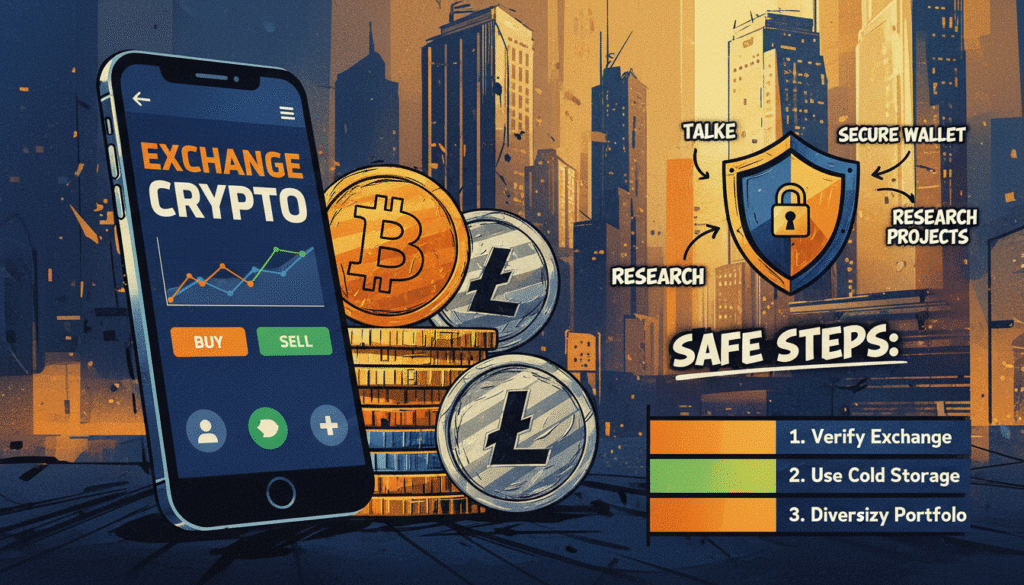
Start by choosing one clear target asset and a small test amount before adding larger funds. This builds confidence and reveals any platform quirks without big risk.
Picking a starter asset
For beginners in Singapore, favour widely adopted cryptocurrencies such as Bitcoin (BTC) or Ethereum (ETH). These tokens have deeper markets and more reliable price discovery.
Smaller altcoins can move far more on speculation. Lower market depth and hype-driven pumps raise the chance of sharp losses. Size positions smaller when exploring these assets.
Market order vs limit order
A market order executes quickly at the best available price. Use it when execution speed matters and the market is stable.
A limit order sets the exact price you will accept but may not fill. Choose it to avoid bad fills during volatile swings or when you want price control.
Review the order screen before confirming
Always check: token name, network (if shown), unit price, amount, spread, and total fees. Confirm the final total in SGD before pressing confirm.
| Item | What to check | Why it matters |
|---|---|---|
| Token | Correct ticker and name (e.g., BTC, ETH) | Prevents wrong-asset transfers and losses |
| Order type | Market or limit | Controls execution speed vs price certainty |
| Unit price & spread | Compare instant-buy price vs trading screen | Reduces hidden cost from wide spreads |
| Amount & total | Exact SGD outlay and received units | Avoids surprise charges and rounding errors |
| Fees | Deposit, trading, and withdrawal fees | Affects net position and future moves |
Practical micro-example: place S$50–S$200 on BTC or ETH as a trial. Confirm the unit price, the received amount, and all fees shown. This small step helps you learn order fills and withdrawal timing.
Tip: avoid FOMO. Use limit orders or small recurring purchases (dollar-cost averaging) during big moves. Remember, a purchase is one step—secure storage and withdrawal testing belong in the next stages.
Don’t Leave Coins on the Exchange Longer Than Necessary
Treat an exchange like a hot workbench — useful for activity, but not a secure vault for long-term holdings. Not your keys, not your coins still sums the core custody idea: using an exchange adds third-party risk even when the platform looks safe.
When it makes sense to keep funds on an exchange
Keeping small amounts on an exchange is reasonable for active trading, frequent rebalances, or open limit orders. Traders who need immediate liquidity may hold only what they plan to move within a few days.
Set a clear boundary: only keep what you will use over the next 24–72 hours or for a defined trading session.
How accounts get compromised without a platform breach
Even if an exchange itself is intact, user accounts can be taken via phishing, email takeover, SIM swap, or malware that steals session tokens. Security.org warns that such losses are often unreimbursed when the root cause is user-side compromise.
- Mitigations: use an authenticator app for 2FA, enable withdrawal allowlists, keep a dedicated email for exchanges, and review balances daily or weekly.
- Create a “sweep” habit: after purchases settle, move long-term assets into a personal wallet you control.
- Set calendar reminders monthly or quarterly to review holdings on exchanges and trim exposure over time.
Next up: moving coins off an exchange requires basic wallet knowledge, private keys, and address hygiene — covered in the next section.
Understand Crypto Wallets, Private Keys, and Seed Phrases
A wallet does not hold tokens like a bank account. A wallet stores the private key that proves ownership and signs transactions on the blockchain.
What private keys mean
Private keys are secret codes. Whoever controls private keys controls the assets. Protecting those keys is the core of secure ownership.
Seed words and recovery phrases
A seed phrase (recovery phrase) restores a crypto wallet anywhere. If someone sees your seed words, they can take funds. If you lose them, you may lose access permanently.
Address safety and transfer habits
Blockchain addresses are long. One wrong character can cause permanent loss. Use copy-paste and verify the first and last characters before sending.
- Write seed phrases offline; never screenshot or store in cloud storage.
- Never share seed words with anyone claiming to be support.
- Send a small test transfer before moving larger balances.
| Item | Purpose | Best practice |
|---|---|---|
| App PIN / password | Local access control | Use strong PIN; still keep seed offline |
| Seed phrase | Full wallet recovery | Store on paper or metal; multiple secure copies |
| Test transfer | Verify address and network | Send small amount first, confirm arrival |
Pick the Right Storage: Hot Wallets vs Cold Wallets
Choose storage that fits your habits and the amount you plan to protect. A clear split between spending funds and long-term holdings reduces risk and confusion.
Hot wallets for convenience and frequent transactions
Hot wallets run on internet-connected devices. They work well for regular trading or small spending balances.
Trade-off: they are more exposed to malware, phishing, and browser-based attacks.
Cold wallets for long-term holding
Cold wallets keep private keys offline. That lowers the remote attack surface and suits long-term storage.
Hardware wallets: what they do and remaining risks
Hardware devices sign transactions without ever revealing keys. Popular models range roughly US$49–US$220.
Risks include physical theft, supply-chain tampering, and losing the recovery phrase. Budget them when your holdings justify the cost.
Why paper wallets are usually not recommended
Paper key generation and handling errors can void the offline benefit. Usability problems raise loss risk for most users.
Practical rule of thumb for Singapore investors
- Keep “spending/trading” funds in hot wallets for quick access.
- Move savings or long-term investment amounts into cold wallets.
- Operational checklist: buy from official stores, verify packaging, set up offline, and secure seed backups.
| Storage | Best for | Key risk |
|---|---|---|
| Hot wallets | Frequent trades, small balances | Online attacks, phishing |
| Hardware cold wallets | Long-term holdings, larger amounts | Physical loss, recovery phrase theft |
| Paper wallets | Rare, specialist use | Generation error, physical damage |
Avoid the Most Common Crypto Scams Targeting Singapore Users
Scam activity in Singapore surged in recent years, with losses topping S$1.1 billion in 2024 and many cases linked to digital asset transfers. That local context matters: attackers now focus on familiar platforms and routine transactions.
Common scam patterns and verification habits
Phishing links and fake websites mimic real exchanges to steal login details. Malicious “connect wallet” prompts can drain funds without obvious signs.
Verification habits: type important URLs manually, bookmark official domains, and check app publisher names before installing.
Fake apps, support impersonators, and malware
Cloned apps and unsolicited DMs claim to help with account recovery but ask for secrets. Keystroke logging and other malware can capture credentials on hot devices.
Non-negotiable rule and immediate response plan
Never type seed words into any website, chat, or form. No legitimate support team will ask for them.
| Scam type | Verification step | Immediate action if targeted |
|---|---|---|
| Phishing site | Compare domain, check SSL, use bookmarks | Close browser, change passwords, alert platform |
| Fake app | Confirm developer, reviews, official site link | Uninstall, scan device, report store listing |
| Support impersonation | Reject requests for secrets, call official support | Block sender, report, follow platform recovery steps |
| Malware / keylogger | Keep OS/apps updated, avoid sideloads | Disconnect, run antivirus, move funds if safe |
Mini-plan if you suspect compromise: freeze accounts where possible, disconnect devices, rotate passwords, contact services via official channels, and consider moving remaining funds after checking device safety.
Ongoing Security and Risk Management After You Buy
“Security for your holdings is a continuous practice, not a one-off checklist.”
Keep regular habits that protect access and preserve value over time. Backups, device hygiene, and quick account reviews matter as much as initial setup.
Secure backups that survive disasters
Store seed phrases offline and out of sight. Use fire- and water-resistant storage, and keep copies in separate secure locations.
Warning: photos, cloud drafts, and email copies are common failure points. Limit who knows backup locations.
Network safety on the move
Avoid public Wi‑Fi for transactions in cafes and airports. If you must, use a reputable VPN and never approve wallet prompts without checking the request.
Position sizing and managing volatility
Limit exposure to an amount you can afford to lose. Use recurring small buys, clear rebalancing rules, and write down your investment plan so emotion does not drive decisions.
- Test recovery: confirm you can restore a wallet from backup without exposing seed words.
- Review device permissions and update software regularly.
- Set calendar reminders for periodic security checks.
| Focus | Practical step | Benefit |
|---|---|---|
| Backup | Offline paper or metal, separate locations | Survives fire, water, theft |
| Network | Avoid public Wi‑Fi; VPN when needed | Reduces account compromise risk |
| Position sizing | Limit exposure; use dollar-cost averaging | Manages market swings and emotional stress |
Final note: treat security like a checklist. Small, regular steps protect long-term returns and keep your investment plan on track.
Conclusion
A simple, repeatable checklist beats luck when protecting digital assets.
Follow one clear workflow: choose a reputable exchange, secure your account with an authenticator app and a unique password, fund an account using a trusted payment route, place a small test purchase, then withdraw holdings into a wallet you control.
Keep most funds off exchanges unless you trade often. Match wallet type to risk: hot wallets for everyday use, cold wallets for larger, long-term holdings.
Watch for scams in Singapore: verify official URLs, confirm app publishers, and never share seed phrases or login codes. This guide is for informational purposes only; do your own research or consult a licensed adviser before larger moves.
Start small, test a withdrawal, and build a repeatable safety habit every time you interact with the cryptocurrency market.